
9io.ai / Hire AI engineers
Hire senior AI engineers, by the hour.
Engineers who have shipped assistants, search, agents and voice features to real users, and who build the tests and infrastructure that keep them working after launch.
You see who'd do the work before you sign. They usually start within a couple of days, and you pay only for the hours they work.
Plans start at $5,000. Senior people only.
AI features that held up with real users.
We don't name clients. Each of these is a write-up of work we did, with the numbers and the parts that went wrong.
An assistant that answers in about 3 seconds
An in-app assistant on an AI study platform took 20 to 30 seconds to say its first word. We brought it down to about 3.
How we did it →A stylist that replies twice as fast
An AI stylist for a fashion commerce platform, with its median response cut from 30 seconds to 13 to 15, and the four changes that did it.
Read the field note →Search by photo
Visual product search for a fashion catalogue, with three image-embedding models compared on the same products.
See the comparison →A voice tutor that draws
A tutor built on realtime speech models that talks a student through a problem and draws on the screen while it does.
Read the field note →MCP servers for every client
Servers with OAuth that work in Claude, ChatGPT, Cursor and VS Code, so one integration reaches every assistant your customers use.
How we built them →Research with two reviews and a judge
The LLM pipeline inside 9io Alpha, where separate passes argue for and against before one verdict is written.
See the pipeline →Four ways to hire AI engineers, and when each fits.
Each of these is the right answer for someone. Our guide to hiring AI engineers has the salaries, rates and time to hire for each, with sources.
Hire in-house
Right when AI is the product and the knowledge has to build up inside people who stay. Expect a long search for someone senior, and a salary that starts before the feature does.
A freelancer
Right for a small, well-defined task you can specify and review yourself. Someone on your side still has to own the evaluation set, the infrastructure and how the pieces fit.
A talent marketplace
Right when you have a technical lead who can manage another engineer. The marketplace finds the person; the architecture and the day-to-day are still yours. Our Toptal alternatives post compares the main ones.
A studio, by the hour
Right while you're proving what to build, or when the feature has to ship before a hire would even start. You get senior AI engineers, a fractional CTO when the build needs one, and the tests and infrastructure as part of the work.
Three steps, no surprises.
Tell us what you're building
One email is enough: what the AI feature should do, what data it touches and where the product is today. No forms, and no sales call you have to sit through.
Get a proposal
Who'd do the work, how many hours, and the rate for each person. Cut anything you don't want before you sign.
Start within days
Usually within a couple of days of agreeing. A staging link early on, a test set in the first weeks and a short update every Friday.
We run an AI system of our own, every day.
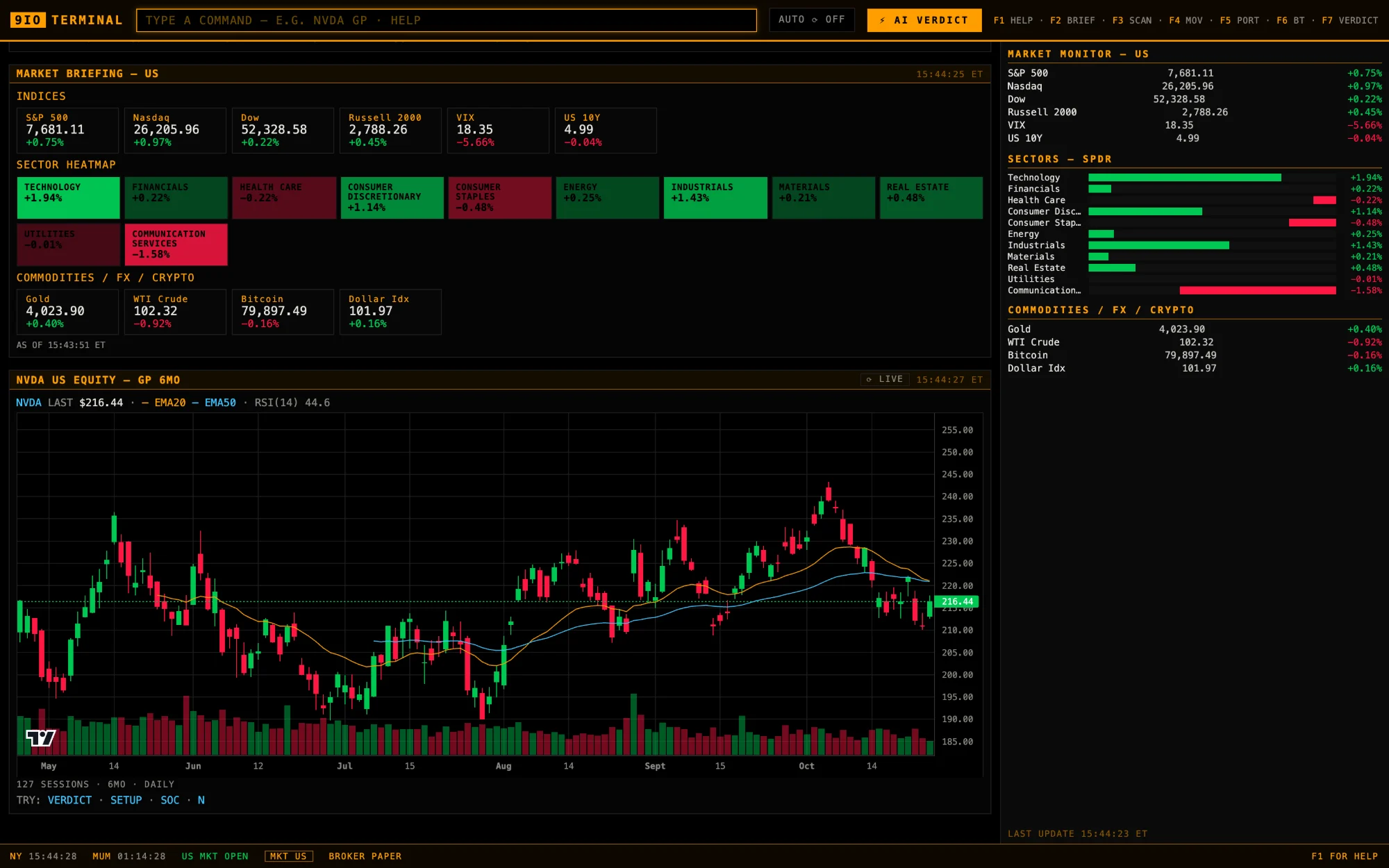
9io Alpha is a market research platform we designed, built and run. Several AI passes argue the case from different angles, and a final pass reconciles them into one write-up with its reasoning intact.
It never acts on its own: every conclusion is put in front of a person. Living with it every day is how we learned what an AI feature needs after launch, and it's why every build we take on gets a test set.
More on our AI engineering →- GroundedEvery conclusion tied back to the evidence that produced it.
- TestedA test set for every build, so a model upgrade gets a score before it ships.
- Human-firstThe system presents; a person decides.
Questions we get a lot.
How much does it cost to hire an AI engineer?
Plans start at $5,000. We don't publish hourly rates, because the honest number depends on which roles you need and for how long; they're in the proposal before you commit to anything. If you're weighing it against a salary, our guide to hiring AI engineers has the in-house and freelance figures.
How quickly can an AI engineer start?
Usually within a couple of days of agreeing a proposal. If we can't start that quickly, we say so before you sign.
Can we hire one AI engineer instead of a team?
Yes. You can take only the roles you're missing, and add a fractional CTO, a designer or QA later if the work needs them. The proposal says which roles we think the build needs and why, and you can cut any of them before you sign.
Who owns the code, the prompts and the data?
You do. Code, history and infrastructure definitions live in your repository from the first commit, and ownership passes to you as you pay. The model provider accounts are in your name, so the meter and your data stay with you.
Should we hire a freelance AI engineer or a studio?
A freelancer suits a small, well-defined task that someone on your side can specify and review. A studio suits an AI feature that has to be designed, tested and run as part of a product, where someone has to own the evaluation set, the infrastructure and the joins between them. Here that's us.
Which models and tools do your AI engineers use?
Whatever the problem needs. Our work has used OpenAI's GPT-5-class models and Realtime, Google's Gemini, Anthropic's Claude, and open models such as SigLIP and SAM 2, built with Python, FastAPI, TypeScript, Postgres and vector search, and deployed on AWS or GCP.
Before you hire anyone.
How to hire AI engineers in 2026
In-house, freelance, agency or studio: salaries, rates, time to hire, and who owns the evals in each.
Read the guide →What it costs to build an AI agent app
A cost model that shows its working, from build hours to monthly running costs per 1,000 users.
See the costs →Upwork alternatives for developers
Upwork's fees, then eight alternatives compared, from Contra and Arc to Toptal and a studio.
Compare them →Tell us what you're building.
Describe the AI feature, the data it touches and where the product is today. You'll get a straight read on the engineers it needs, and on whether it needs AI at all.
Replies come from the person who'd do the work.