
Key takeaways
- Chakri is a free Diwali party game that runs in a phone’s browser, with no app or sign-up.
- Jodi Check is a 12-question quiz for two people, and every right guess lights a diya.
- Chakri Truth or Dare takes 2 to 12 players, with four decks and three laddoos each for skips.
- No dare involves fire, firecrackers, drink or going outside, and the Family deck is safe in front of Dadi.
- Names stay on the phone, and each game ends with a story-sized card you can share.
Chakri is a free Diwali party game you play on one phone. Open chakri.9io.ai in the phone’s browser and choose one of two games. Jodi Check finds out how well two people really know each other. Chakri Truth or Dare is for 2 to 12 players, with the phone in the middle and a spinning chakri that decides who goes next. There’s no app to install and no sign-up, and nothing anyone types leaves the phone.
We made Chakri at 9io, and it went live on 29 October 2026. Diwali is on Sunday 8 November this year1, so there’s time for a practice round before the party. The game is in English, with a Hinglish switch at the top of every screen.
This post covers how to play both games, which deck suits which crowd, what the cards will and won’t ask, and what happens to your names. It ends with a checklist for running the game on the night.
What Chakri is and who it’s for
Chakri has two games on its home screen, and each suits a different group. Jodi Check is for two people who know each other well, or think they do. That can be a couple, siblings, best friends, or two people from one family. Chakri Truth or Dare is for a table of 2 to 12, from a family gathering to a late night with friends.
You need one phone with a web browser. If you’re hosting, open the link on your own phone and your guests don’t need anything at all.
The questions and cards are written for Diwali in India and abroad. One Aunty Special card asks “Beta, when are you visiting India next? Already in India? Then when are you visiting Nani?” Others mention time zones, video calls with family far away, and the Indian store running out of kaju katli.
How to play Jodi Check
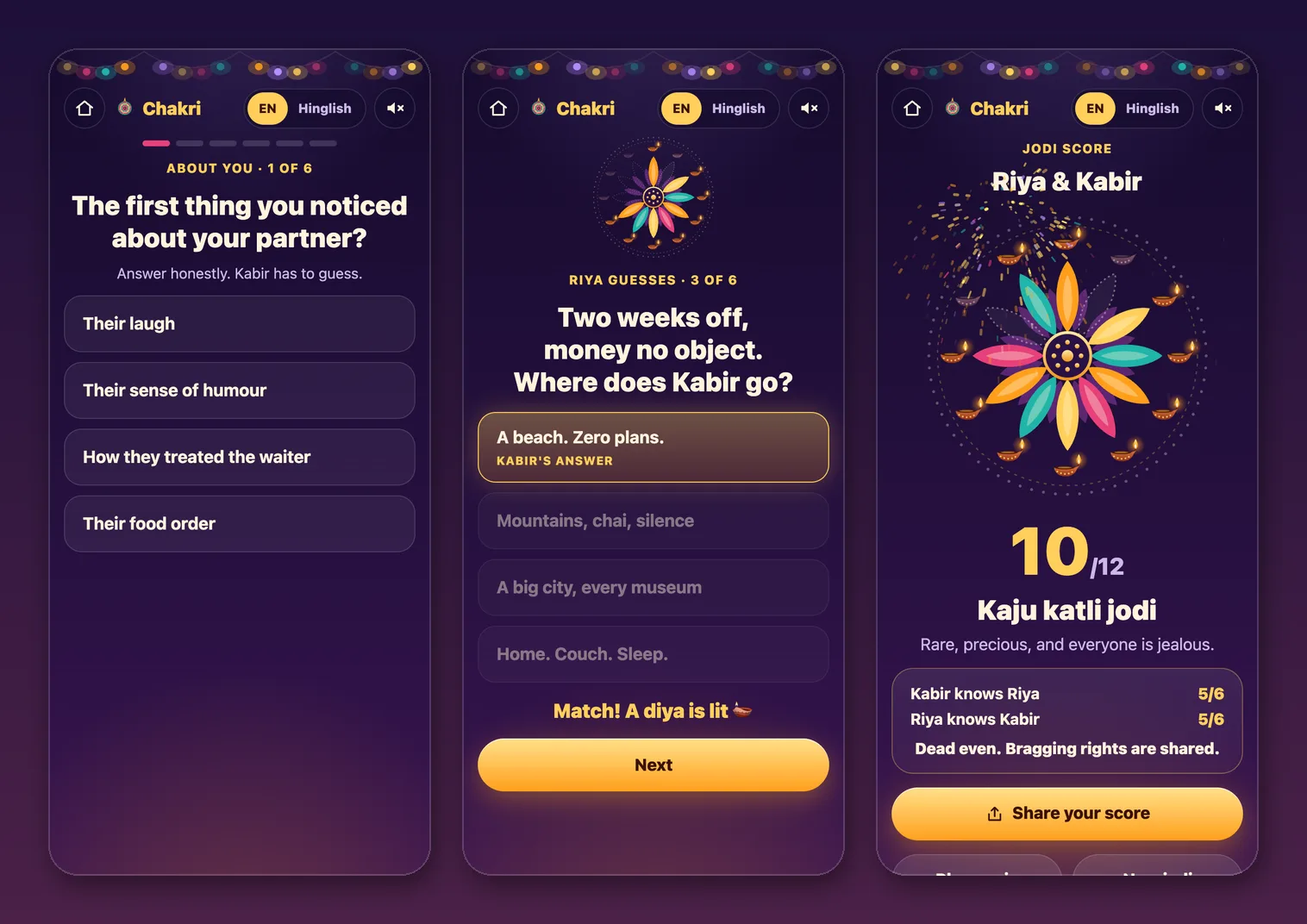
Jodi Check asks “How well do you really know each other?” Two players share one phone for 12 questions, six about each of them. With the Couple jodi it works as a couples quiz for Diwali, and the Siblings jodi is labelled “Bhai Dooj ready”.
- Pick your jodi. Choose Couple, Siblings, Best friends or Family, and type both names. Five of the 12 questions come from that jodi’s own set, and the other seven come from questions for everyone.
- Hand the phone to the first player. The first name you typed answers first. The screen tells the other player, by name, to look away.
- Answer six questions in secret. Each question has four answers to pick from. If you tap the wrong one, “Change my last answer” takes you back a question.
- Pass the phone back. After the sixth answer, the game asks you to hand the phone over, and the player who answered can watch from then on.
- Guess each answer. The guesser gets the same six questions about the other player and taps the answer they expect. A match lights a diya in the rangoli, and a miss shows the real answer.
- Swap. Halfway through, the game shows the first score out of 6. Then the two of you swap roles for six more questions.
- Finish the rangoli. Light all 12 diyas to complete it. The result shows your score out of 12, a title, and how many each of you got right about the other. The better guesser wins bragging rights, and a tie means they’re shared.
A typical question is “Someone gifts you a box of soan papdi. Its fate?” The answers to pick from are “Re-gifted within 24 hours”, “Eaten. Proudly.”, “Still in the cupboard next Diwali” and “Passed on to the neighbours”. The guesser then sees the same question with the other player’s name in it.
The title depends on the total score.
| Score out of 12 | Title | What the game adds |
|---|---|---|
| 12 | Made in the same factory | Every single diya lit. Frankly, suspicious. |
| 10 to 11 | Kaju katli jodi | Rare, precious, and everyone is jealous. |
| 7 to 9 | Gulab jamun jodi | Sweet, a little syrupy, very solid. |
| 4 to 6 | Soan papdi jodi | Passed around for years. Never actually opened. |
| 1 to 3 | Same Wi-Fi, different worlds | You share a password. That’s about it. |
| 0 | Strangers at the same party | Introduce yourselves. Then play again. |
Jodi Check has 82 questions as of 29 October 2026, with 32 for everyone, 14 for couples and 12 each for siblings, best friends and family. Play again keeps the same jodi and deals new questions. The phone remembers which questions you’ve had recently and puts fresh ones first. New jodi goes back to the start for the next pair.
How to play Chakri Truth or Dare
Chakri Truth or Dare is a Diwali truth or dare game for 2 to 12 players. Put the phone flat in the middle, where everyone can see it.
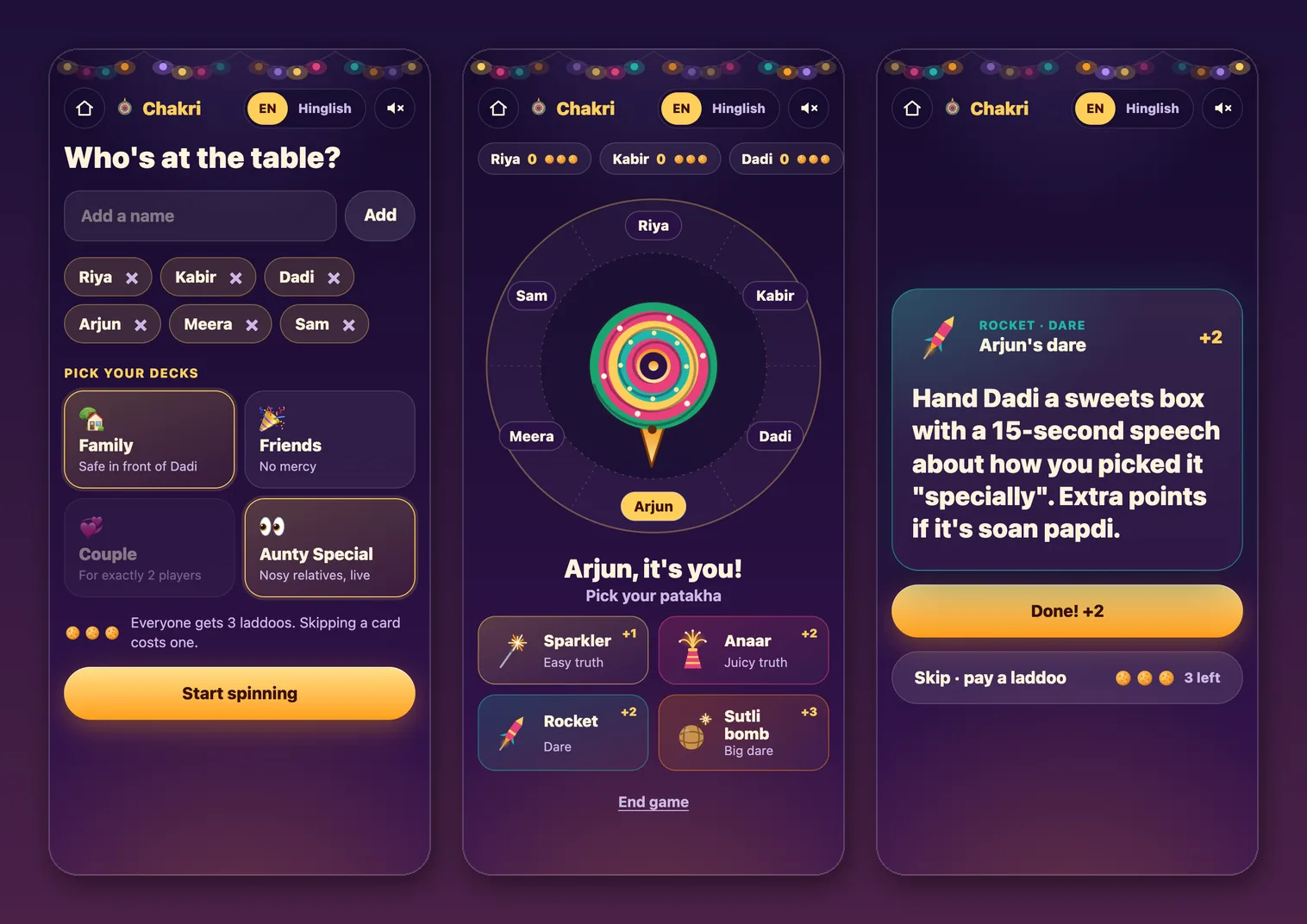
- Add the players. Type each name and tap Add. You need at least two, and the table is full at twelve.
- Pick your decks. Switch on any mix of Family, Friends, Couple and Aunty Special. Couple can only be chosen when exactly two people are playing.
- Remember the laddoos. Everyone starts with 3, and skipping a card costs one.
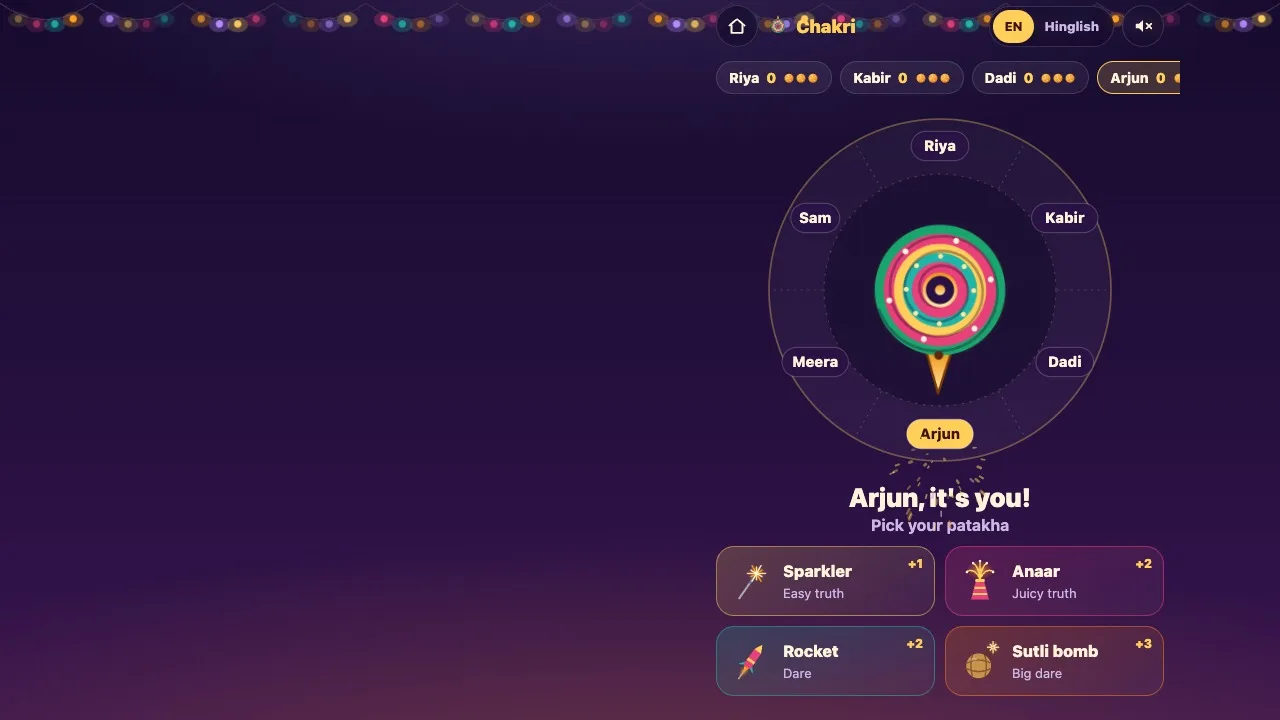
- Spin the chakri. Swipe it, or tap Spin. It crackles, sprays sparks, ticks past the names and stops on someone. A harder swipe spins it for longer.
- Pick a patakha. The player it stops on picks one of four firecrackers, from an easy truth to a big dare. A card comes up with their name on it.
- Do it or pay a laddoo. Tap Done to take the points, or Skip to pay a laddoo and pass. With no laddoos left, the game says “No laddoos left. You have to do it!”
- End the game when the night is done. There’s no fixed number of rounds. When you’re ready to stop, someone taps End game.
The game decides who the chakri will land on before it starts moving, and it plays fair. It never picks the same player twice running, and anyone who has had fewer turns is likelier to come up. With two players, it simply alternates.
The patakha you pick sets the points.
| Patakha | What you get | Points | A card from the Family deck |
|---|---|---|---|
| Sparkler | Easy truth | 1 | “Team kaju katli or team soan papdi? Defend your team in one sentence.” |
| Anaar | Juicy truth | 2 | “Have you ever secretly eaten the sweets that were meant for guests?” |
| Rocket | Dare | 2 | “Balance a laddoo (or any sweet) on a spoon and walk once around the table without dropping it.” |
| Sutli bomb | Big dare | 3 | “Give a 30-second live news report from the sweets table. Breaking news: the kaju katli is almost gone!” |
Some cards pull in a second player at random, like the Friends dare that starts a 45-second dance-off with someone else at the table. Within a game, a card won’t come up twice until every card for that patakha in your decks has been played. With Family and Aunty Special switched on, that’s 22 cards for each patakha, 12 from Family and 10 from Aunty Special.
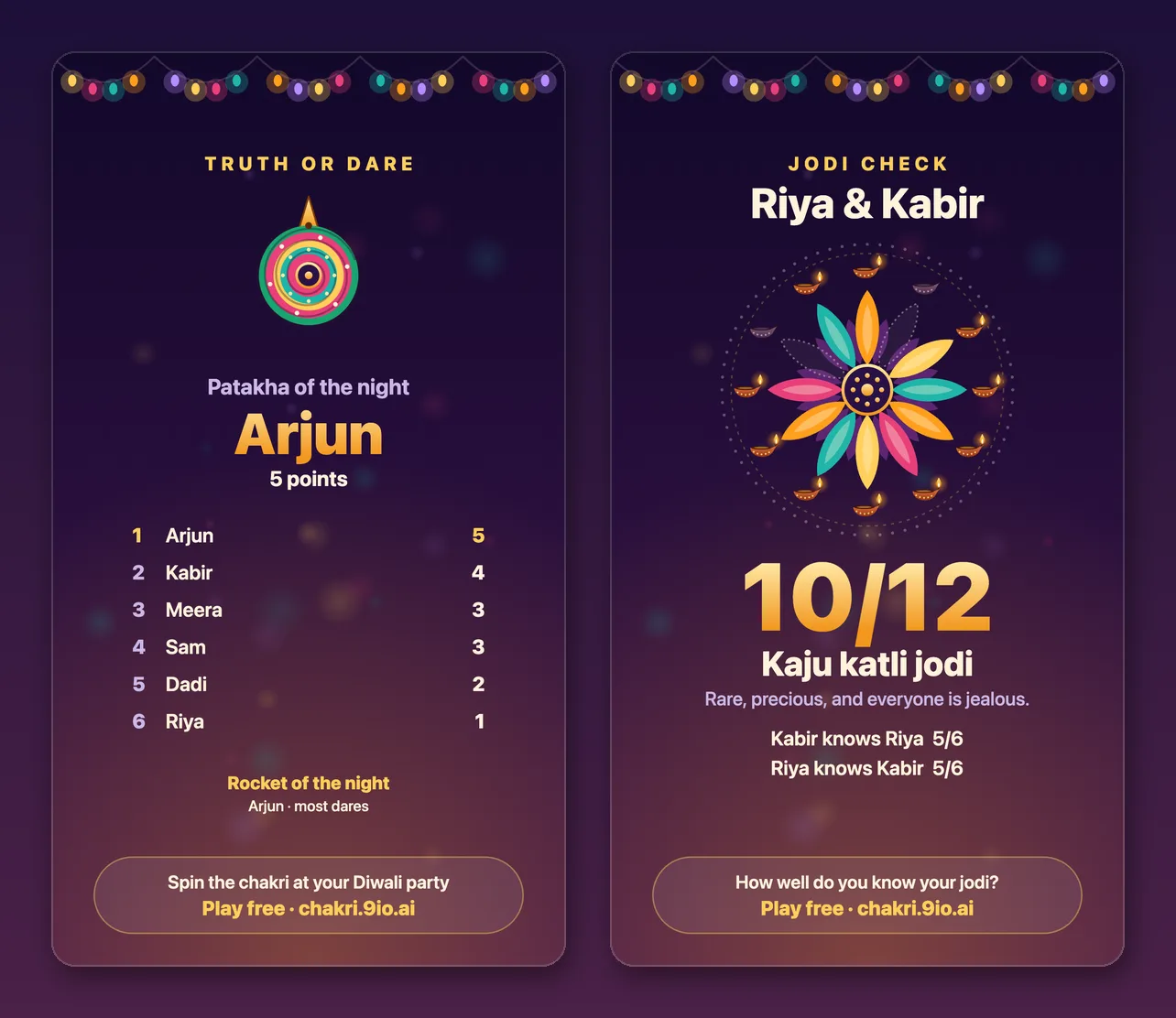
End game brings up the Patakha of the night, the player with the most points. A tie goes to whoever has more laddoos left. Below that come everyone’s scores and up to three awards. Rocket of the night goes to the player who did the most dares, and Laddoo lover to the one who skipped the most. Laddoo hoarder goes to the only player who never skipped, if they had at least two turns. Each award only appears when one player clearly earned it.
If someone taps End game too early, Keep playing takes you back to the chakri with the scores as they were. Play again starts a new game with the same names.
The four decks and who each one suits
Truth or Dare has four decks, and you can mix them. When you first open the game, Family and Aunty Special are switched on. Each deck’s cards are split evenly across the four patakhas, and the counts below are as of 29 October 2026.
| Deck | What the game calls it | Cards | Who it suits | A card from it |
|---|---|---|---|---|
| Family | Safe in front of Dadi | 48 | Mixed ages, with grandparents in the room | “Act out a Diwali video call with Nani where the screen keeps freezing mid-sentence.” |
| Friends | No mercy | 48 | Friends who already know each other’s secrets | “Have you ever sent a message meant for friends to the family group chat? How bad was the damage?” |
| Couple | A little spicy, just the two of you | 40 | A couple playing on their own | “What did you almost say on your first date or first meeting, but didn’t?” |
| Aunty Special | Nosy relatives, live | 40 | Cousins, and anyone who has been asked about their wedding plans at a party | “Beta, Sharma ji’s son became a doctor. Why didn’t you? Your best excuse, please.” |
In Aunty Special, the phone plays the nosy aunty or uncle and the player answers it. Its dares turn the tables and have you play the relative. One asks for the classic desi goodbye, which means 45 seconds of saying bye to everyone, one by one, without leaving.
For a list to read out without a phone, see our Diwali truth or dare questions for family, friends, couples and nosy aunties.
What the cards will and won’t ask
Chakri is about the social side of Diwali. That’s the food and sweets, the lights, family, nosy relatives, card nights and the box of soan papdi that gets passed from house to house. The game leaves the religious side of the festival alone, so everyone who celebrates the season can play.
Firecrackers come up as memories in a few questions, such as which one scared you most when you were little. No dare involves fire, firecrackers, diyas, drink or smoke. None sends anyone outside, and none asks you to message someone who isn’t in the room. The dares that mention firecrackers are for acting out, like “Be a sutli bomb that turns out to be a dud: fizz dramatically for 10 seconds, then… nothing.” The game’s own tests check the dares for words such as fire, candles, alcohol and smoke.
The Couple deck is flirty without being explicit, and it only opens for exactly two players. The dares that ask for a hug, a slow dance, a word written on the palm or a sweet fed by hand all check that your partner is up for it.
The Family deck is labelled “Safe in front of Dadi”, and it’s the one to pick when grandparents or children are playing.
Play in English or Hinglish
The game opens in English. The EN and Hinglish switch at the top of every screen changes the whole game, from the buttons to the questions, cards and result titles. Hinglish here means Hindi and English mixed together and written in Roman letters. There’s no Devanagari version. The phone remembers your choice for next time.
| English | Hinglish |
|---|---|
| Spin the chakri. Pick your patakha. No backing out. | Chakri ghumao. Patakha chuno. Peeche hatna mana hai. |
| Beta, what’s your salary? Answer only in boxes of kaju katli per month. | Beta, salary kitni hai? Sirf kaju katli ke dabbon mein batao, per month. |
Some names change too. The Sparkler becomes the Phuljhadi, the Friends deck becomes Dost, and “Safe in front of Dadi” becomes “Dadi ke saamne bhi safe”.
Hindi verbs often change with the gender of the person they’re about, so “will you do it?” is “karoge?” to a man and “karogi?” to a woman. Chakri’s Hinglish avoids those forms, so a card reads right whoever the chakri lands on. The game’s tests check every Hinglish line for the common ones.
Nothing leaves the phone until you share the card
You don’t sign up or make an account. Names and answers stay on the phone you’re playing on. To make the next game quicker, the browser on that phone remembers the language, whether sound is on and the last names you typed. It also keeps the decks or jodi you chose and the Jodi Check questions you’ve had recently. Jodi Check answers aren’t saved at all, and clearing the browser’s data for the site removes the rest.
Both games end with a result card of 1080 × 1920 pixels, the shape of a phone story. The game draws it on the phone, so nothing is uploaded to make it. The Jodi Check card shows both names, the rangoli, the score out of 12, the title and who knows whom. The Truth or Dare card shows the Patakha of the night, the top six on the scoreboard and the awards. Both carry the game’s address at the bottom.
Tap “Share your score” in Jodi Check or “Share the night” in Truth or Dare to see the card. Share opens the phone’s own share sheet, with the picture attached when the browser can share files. Send on WhatsApp opens WhatsApp with a short message and the link, without the picture. Save image keeps the card on the phone, and Copy text copies the message.
Why our Diwali party game is a web page
Diwali comes once a year, and we didn’t want anyone to install an app for one night. A party game without an app starts from a link, and nobody has to make an account. The result card is an ordinary image, so it goes to WhatsApp or a story like any other photo.
The game runs online in the browser, but it doesn’t link phones together. Everyone plays on the one phone in the room.
For the engineers who read this blog, Chakri is plain HTML, CSS and JavaScript modules, with no build step, no framework and no dependencies. All the art is SVG drawn in code. Fireworks and sparks run on one canvas and calm down for anyone whose phone asks for reduced motion. Every sound is synthesised with Web Audio, and nothing is sampled. The tests run on Node’s built-in test runner and check every question and card in both languages, along with the rules of both games. The server sends the HTML, JavaScript and CSS with Cache-Control: no-cache, so a fix during Diwali week reaches phones the next time they load the page. We wrote up how Chakri is built separately, from the SVG art to the synthesised sounds.
When Diwali falls in 2026
India’s central government lists Diwali (Deepavali) on Sunday 8 November 2026, and its holiday memo notes that some states mark it a day earlier, on Naraka Chaturdashi1. Drik Panchang’s calendar puts Lakshmi Puja on Sunday 8 November in New Delhi, London and New York, with Dhanteras on Friday 6 November2.
Bhai Dooj is the date that moves with the city. Drik Panchang has it on Wednesday 11 November in New Delhi and on Tuesday 10 November in London and New York2. If you’re saving a siblings’ round of Jodi Check for Bhai Dooj, check the date for your own city.
Tips for running Chakri at your Diwali party
- Open it before guests arrive. Type the names in once. The phone remembers the last ones you typed.
- Choose decks for the room. Use Family on its own when grandparents or children are playing. Add Aunty Special for a room of cousins, Friends for a late night, and Couple when it’s just the two of you.
- Explain the laddoos before the first spin. Everyone has three, a skip costs one, and with none left you have to do the card.
- Leave the turns to the chakri. It keeps them even, so nobody has to keep count.
- Use nicknames in a big group. With more than eight players, names longer than seven letters get shortened on the wheel.
- Stop when the room is done. Tap End game. If that was too early, Keep playing goes back to the chakri with the scores intact.
- Trust the back button. It asks “Leave this game?” before it throws a game away.
- Set the sound and motion. The speaker button at the top turns sound and vibration on or off. Turning on reduced motion in the phone’s accessibility settings calms the fireworks down.
- Post the picture. Share or Save image gives you the card itself. Send on WhatsApp sends only the message and the link.
-
Department of Personnel and Training, Government of India, “Holidays to be observed in Central Government Offices during the year 2026”, Office Memorandum F.No. 12/2/2023-JCA, 3 July 2025, https://documents.doptcirculars.nic.in/D2/D02est/Holidays%20to%20be%20observed%20in%20Central%20Government%20Offices%20during%20the%20year%2020265vgBs.pdf ↩↩
-
Drik Panchang, “2026 Diwali Puja Calendar” for New Delhi, https://www.drikpanchang.com/diwali/diwali-puja-calendar.html?geoname-id=1261481&year=2026, London, https://www.drikpanchang.com/diwali/diwali-puja-calendar.html?geoname-id=2643743&year=2026, and New York, https://www.drikpanchang.com/diwali/diwali-puja-calendar.html?geoname-id=5128581&year=2026 ↩↩
Frequently asked questions
Is Chakri free to play?
Yes. Chakri is a free web game at chakri.9io.ai. There’s no sign-up and nothing to pay for.
Do I need to download an app to play Chakri?
No. Chakri is a Diwali game you play online, in your phone’s web browser, so there’s nothing to install. Open chakri.9io.ai on one phone and pass it round.
How many people can play Chakri?
Jodi Check is for two players. Chakri Truth or Dare takes 2 to 12 players on one phone, and its Couple deck is only for exactly two.
Is Chakri OK to play with family and kids?
Yes, with the Family deck, which the game describes as safe in front of Dadi. No dare in any deck involves fire, firecrackers, drink, smoke or going outside, and the Couple deck only opens when exactly two people play.
Can we play Chakri in Hindi?
Chakri has a Hinglish switch at the top of every screen. Hinglish mixes Hindi and English in Roman letters, as in ‘Chakri ghumao. Patakha chuno.’ There’s no Devanagari version.
Does Chakri save our names or answers anywhere?
Nothing leaves the phone. The browser on that phone remembers the language, the sound setting and the last names you typed, so the next game starts quicker. Jodi Check answers aren’t saved at all.
Building something like this?
9io is a small team of senior engineers with a fractional CTO. We work by the hour, and plans start at $5,000. Send us a note about your product. The reply comes from the person who'd do the work.