
Key takeaways
- In 311 top-level penalties, no kick into the upper third of the goal was saved.
- Keepers dived on 93.7% of 286 penalties, though staying central stopped more of the kicks they faced.
- Kicks down the middle scored 81% in 459 French and Italian top-flight penalties.
- Takers who responded fastest to the referee’s signal missed more often in 366 shootout kicks.
- Football Kick’s keepers guess less often than real ones, so the middle gets saved more in the game.
The research on where to aim a penalty favours the top of the goal. In 311 penalties from top leagues and championships, no kick into the upper third of the goal was saved, though only 12.9% of kicks went there.1 Most went low, and 19.8% of those were saved. The middle works more often than it feels like it should: in 459 penalties from the French and Italian top divisions, kicks down the middle went in 81.0% of the time, because keepers almost never stayed there.2 Studies of how takers and keepers pick sides also find that professionals mix their choices, so a favourite spot is a weakness.
We make Football Kick here at 9io. It’s a one-finger football game for iPhone and iPad, made for iPhone Duo, and as of 30 October 2026 it’s on its way to the App Store. Its keepers face the same problem real ones do, each with their own reaction time, reading error, habit of guessing and reach. You can test the research against them free in a browser, in the game’s Penalties mode at footballkicks.9io.ai.
The first half of this post covers the studies. The second shows how Football Kick models the same duel and how to use the research in its Penalties and Shootout modes, with a checklist at the end.
Where to aim a penalty, zone by zone
Two studies of real matches give the clearest picture. Michael Bar-Eli and Ofer Azar analysed 311 penalties from top leagues and championships worldwide by the part of the goal they went to.3 Pierre-André Chiappori, Steven Levitt and Timothy Groseclose recorded where the ball and the keeper went in 459 penalties from the French first division (1997 to 1999) and the Italian first division (1997 to 2000).2 Their “natural side” is the one a kicker finds easier. For a right-footer, which about 85% of players are, it’s the kicker’s left and the keeper’s right.
| Where the ball goes | What the studies found | Study |
|---|---|---|
| Upper third of the goal | No kick was saved. Only 12.9% of kicks went this high. | Bar-Eli and Azar, 311 kicks |
| Middle third | 12.6% saved. In an indoor experiment it was the most-saved height, at 33.5%. | Bar-Eli and Azar; Higueras-Herbada and colleagues, 638 kicks |
| Lower third | The most common choice, with 56.6% of kicks. 19.8% saved. | Bar-Eli and Azar |
| Down the middle | 81.0% scored. Kickers went there on 17.2% of kicks and keepers stayed there on 2.4%. | Chiappori, Levitt and Groseclose, 459 kicks |
| Kicker’s natural side | 76.7% scored | Chiappori, Levitt and Groseclose |
| Kicker’s other side | 70.1% scored | Chiappori, Levitt and Groseclose |
Bar-Eli and Azar’s height figures are as cited in a 2020 paper by Higueras-Herbada and colleagues, whose own indoor test had 12 Portuguese second-division and junior players shoot at five young keepers.1 The 2009 abstract says the upper area of the goal was the hardest to stop and that the best strategy “may be to aim to the upper two corners”, with training to keep the miss rate down.3
The middle comes with a condition: it scores well because keepers leave it. In Chiappori’s data keepers stayed central on only 11 of the 459 kicks, and none of the three central kicks that met one of them went in.2
Why keepers dive when staying central saves more
A penalty gives the keeper almost no time. Chiappori and co-authors note that at the top speed a penalty can reach, over 125 mph (about 200 km/h), the ball enters the goal about two-tenths of a second after it’s kicked. The keeper has to choose a side before the ball’s direction can be seen.2 As of 30 October 2026, Law 14 says the keeper must stay on the goal line, facing the kicker and between the posts, until the ball is kicked. At the kick, at least part of one foot must be touching, in line with or behind the line, and the keeper mustn’t unfairly distract the taker, for example by delaying the kick.4
So keepers guess, and nearly always by diving. Bar-Eli, Azar and three colleagues studied 286 penalties from top leagues and championships that reached the goal. Keepers dived on 93.7% of them and stayed in the centre on 6.3%.5 Kickers put 28.7% of the same kicks in the centre. Keepers who stayed stopped 33.3% of the kicks they faced, against 12.6% to 14.2% when they dived.
The 33.3% rests on 18 kicks, and the authors add that staying central only pays while kickers keep shooting to the sides. Their explanation for all the diving is action bias. Diving is what keepers are expected to do, so a goal conceded while standing still feels worse than one conceded after a dive. In a survey for the same paper, 25 of 32 top professional keepers in Israel named diving as the more normal action.
Keepers also lean towards the kicker’s natural side. In Chiappori’s data they went that way on 56.6% of kicks, the other way on 41.0% and stayed central on 2.4%.2
Penalties reward mixing your spots
A penalty is close to a textbook game called matching pennies, in which one player wants the two choices to match and the other doesn’t. Theory says both should mix their choices so that neither can exploit a pattern, which leaves every option equally good. Chiappori, Levitt and Groseclose tested this on their 459 kicks and couldn’t reject its main predictions. Kicker and keeper appear to choose at the same moment, scoring chances couldn’t be told apart across left, middle and right, and the side a player chose last time didn’t predict the next one.2 Ignacio Palacios-Huerta reached the same conclusions from a separate set of penalties.6
Equal odds only hold while takers stay unpredictable. Keepers’ trainers keep records of opposing takers’ habits, as Chiappori’s team noted in 2002. Their data also shows what a correct guess costs the kicker. Kicks to the natural side went in 94.4% of the time when the keeper went the wrong way or stayed, and 63.6% when the keeper guessed right. On the other side the figures were 89.3% and 43.7%.
Picking a spot before the run-up has support too. In a field experiment with ten intermediate-level players, van der Kamp found that the less time kickers had to switch sides in response to a late cue, the more often they sent the ball the wrong way or away from their target.7 Van der Kamp concluded that reacting to the keeper may make penalties worse, mainly because there isn’t time to change the kick.
The Panenka, a chip down the middle
On 20 June 1976 in Belgrade, Czechoslovakia and West Germany drew 2-2 in the European Championship final, and the first shootout in a EURO final came down to Antonín Panenka. Panenka chipped the ball gently down the middle as Sepp Maier dived to one side, and Czechoslovakia won 5-3 on penalties. Panenka told UEFA the kick wasn’t spontaneous and had been practised for two years.8
A chip down the middle beats a keeper who commits early, and in Bar-Eli’s data keepers committed on more than nine kicks in ten. Against a keeper who stays, a slow chip is an easy save, which is the risk every Panenka runs. Law 14 allows a feint during the run-up but makes a feint once the run-up is complete an offence, so any disguise has to happen on the way to the ball.4
Penalty shootout psychology: pressure and rushing
Shootouts add pressure, and it shows in the results. Geir Jordet and colleagues took all 409 kicks from the 41 shootouts at the World Cup, the European Championships and the Copa América between 1976 and 2004. The more important the kick, the worse it went, while skill and fatigue were less related to the result, or not at all.9
Later studies looked at what players do before the kick. Jordet and Hartman took 359 kicks from every shootout held at the World Cup, the European Championships and the Champions League up to their study. When a miss would lose the shootout, players looked away from the keeper or hurried their preparation more often than when a goal would win it, and they scored less.10 In 366 kicks by 296 players from the same three competitions, players who responded faster to the referee’s signal missed more often. The authors suggest players under that much pressure try to get the situation “over with” as soon as possible.11
All of these come from match video, so they show associations. Jordet’s 2007 paper recommends working with players to reduce how important each kick feels.
Kicking first: 60.5% in one study, no edge in a bigger one
A coin toss decides which team kicks first in a shootout, which makes it a natural experiment. Jose Apesteguia and Ignacio Palacios-Huerta found that teams kicking first won 60.5% of 129 shootouts, and they put it down to the pressure on the second team, which usually kicks while trailing.12 After a 2003 rule change let the toss winner choose, teams systematically chose to go first.
Martin Kocher, Marc Lenz and Matthias Sutter then gathered every shootout from six major competitions. In the 262 shootouts from 1970 to June 2003, first-kicking teams won 53.4%, which isn’t significantly different from 50%. Their published paper extended the sample to 540 shootouts and still found no significant first-mover advantage.13
The IFAB trialled an “ABBA” order anyway, in which teams take their kicks in pairs after the first one, and in November 2018 dropped it, citing “the absence of strong support, mainly because the procedure is complex”.14
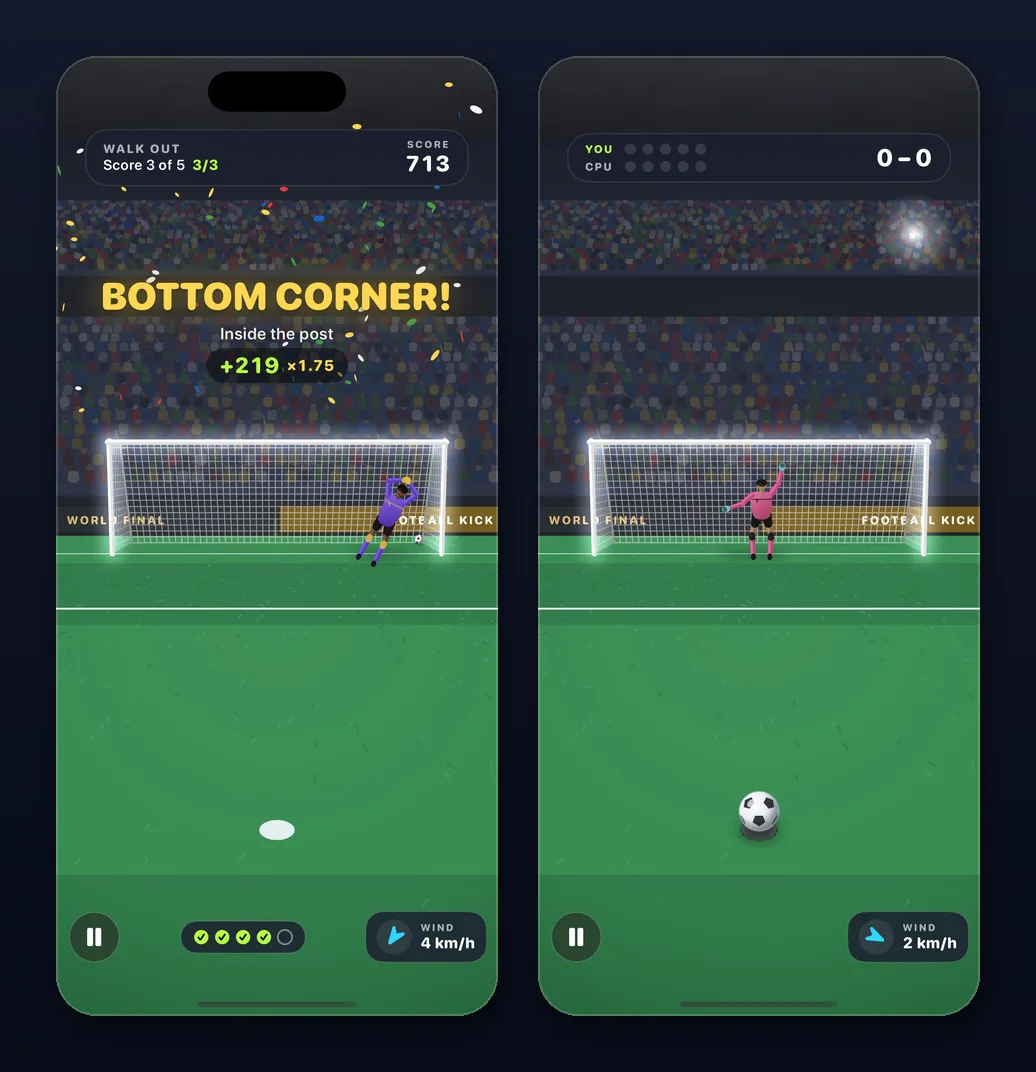
How Football Kick’s keepers face a penalty
Football Kick’s keepers react to the ball. They never see your swipe or where you aimed. At the strike a keeper may commit to a guess, and the better keepers guess more often: at their standard settings, Theo Lund, The Apprentice, guesses on 13% of kicks and Idris Okafor, The Octopus, on 46%. Otherwise the keeper waits out a reaction time, from 0.37 seconds for Theo to 0.16 for Idris, and predicts where the ball will cross the line. The prediction’s error shrinks as the ball gets closer, and every dive is limited by how far the keeper can launch from the line. These figures come from the keeper code as of 30 October 2026, in version 1.0, which we’re finishing now.
| In real penalties | In Football Kick |
|---|---|
| Keepers commit before they can see the ball, and dive on 93.7% of kicks | Keepers guess at the strike on 13% (Theo) to 46% (Idris) of kicks and read the ball the rest of the time |
| Keepers stay central on 2.4% to 6.3% of kicks | A keeper who doesn’t guess starts from the middle of the goal and waits for the ball |
| Keepers lean towards the kicker’s natural side, 56.6% to 41.0% | Gus Pemberton, Big Gus, guesses your left about twice as often as your right, and Viktor Hale, The Lighthouse, leans to your right |
| Trainers keep records of opposing takers’ habits | Kenji Arata, The Reader, and Idris remember your last eight kicks, count the latest three double and guess more often once they’ve seen two |
| A soft chip beats a keeper who goes early | A chip scores as a Panenka only if the keeper has dived to one side |
The first row is the biggest difference from real football. Football Kick’s keepers wait and read the ball far more often than real ones do, which changes the advice on the middle.
Kenji and Idris also take the ball’s spin into account when they predict its line. Rafa Ortega, El Gato, doesn’t, so a curled penalty starts on a line Rafa misjudges and only corrects as the ball gets closer. In free kicks, which are only in the app, a wall screens the keeper, who can’t guess at the strike, reacts 0.18 seconds later and reads the ball less precisely.
Where the game’s keepers get beaten
Football Kick’s test suite holds a table that works like Bar-Eli and Azar’s zones. It plays 60 penalties into each of five spots, at two strengths, against keepers of six ratings, and records how many don’t go in. Here are the two closest to keepers you’ll meet in the browser, one near Rafa Ortega’s level and one at Idris Okafor’s.
| Aimed at | Rafa’s level, medium pace | Rafa’s level, hard | Idris’s level, medium pace | Idris’s level, hard |
|---|---|---|---|---|
| Low corner | 12% | 7% | 62% | 18% |
| Side, 1 m up | 15% | 10% | 45% | 35% |
| Top corner | 3% | 2% | 60% | 7% |
| Middle, low | 80% | 75% | 72% | 60% |
| Middle, high | 75% | 75% | 58% | 58% |
Each figure is the share of 60 penalties that didn’t go in, as of 30 October 2026. In the engine, the medium kicks leave the foot at about 24 m/s and the hard ones at about 31 m/s. The test keepers have no quirks, so they lack Rafa’s weakness up high and Idris’s memory.
Against the weaker keeper, the middle is the worst place to shoot, the reverse of the match data, because a keeper who waits has time to reach anything nearby. Every spot away from the middle works against that keeper. Against Idris, pace decides it: a low corner at medium pace is kept out 62% of the time and a hard one 18%. A hard shot into the top corner is the best choice against both, kept out 2% and 7% of the time.
Where these numbers come from
The table comes from KickKit, the game’s engine. Its keepers command produced it, and the browser version’s parity tests check that the JavaScript port gives an identical table over all 3,600 penalties. Each cell is 60 kicks with different random seeds, from the penalty spot in still air, aimed at a fixed point, against a 1.88 m keeper with no quirks. A kick that misses counts as kept out. The reaction times and guess rates come from the keeper code. We didn’t run new simulations for this post, and we haven’t measured how real players score against these keepers.
Practising in Penalties and Shootout
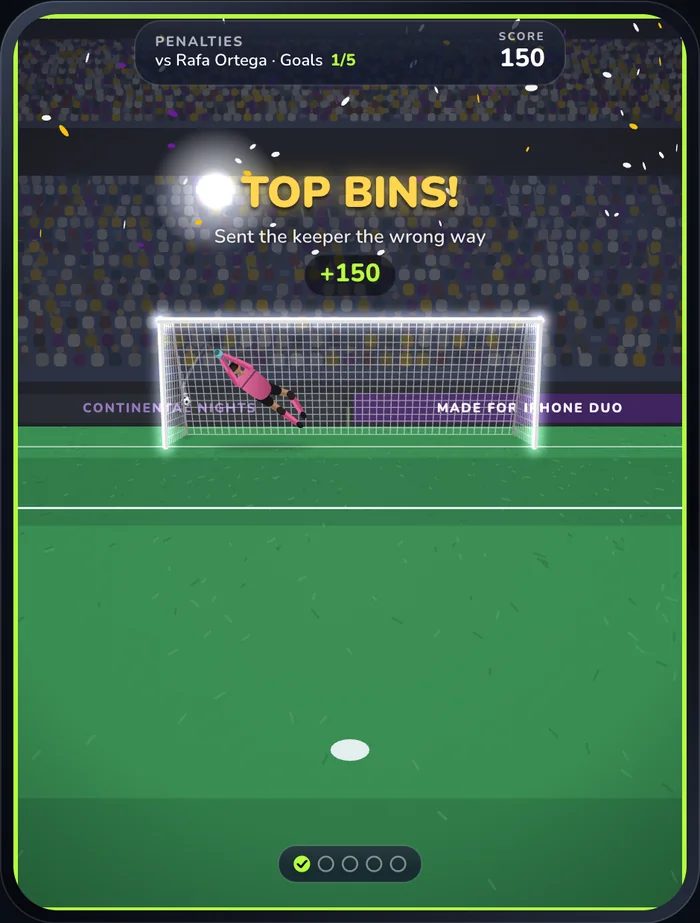
In the browser, Penalties is five kicks against Rafa Ortega under the floodlights at Continental Nights, with no wind, as of 30 October 2026. The first tip the game shows is “Put it in the corners. Rafa covers the middle.” Rafa waves both arms and shuffles along the line before you shoot, is slower to balls above shoulder height, and neither learns your habits nor reads spin. Swipe fast and let go over a top corner, because where you let go is where the ball goes. You get five minutes of play a day, free, with no sign-up.
In Streak the keeper gets better with every goal, and once you’ve scored 14 in a row Kenji Arata takes over. Kenji sorts your last eight kicks into six zones (left, middle or right, low or high), counts the latest three double, and guesses towards the zones you’ve used most, so mix your spots.
In the app, Shootout is five penalties each and then sudden death, against the CPU or a friend on one phone. Against the CPU you take the first kick of every round, the slot Apesteguia and Palacios-Huerta found was the better one, though the larger study found no significant edge. The difficulty you pick decides who’s in goal for your kicks and how sharp the CPU taker is when you’re in goal for theirs.
| Difficulty | Keeper for your kicks | If you dive before the CPU shoots, it goes the other way or down the middle |
|---|---|---|
| Rookie | Gus Pemberton | 46% of the time |
| Pro | Rafa Ortega | 63% |
| World Class | Kenji Arata | 79% |
| Legend | Idris Okafor | 92% |
Kenji and Idris learn from your kicks during the shootout, and from your second kick their guesses lean towards the zones you’ve used. In goal, you face a CPU taker that watches the keeper, so wait for the strike, then tap where to dive; your keeper goes the moment your finger lands. Staying in the middle helps less than the research suggests for real keepers, because the CPU taker favours the low corners and rarely goes down the middle, apart from the occasional chip by World Class and Legend takers.
A chip scores as a Panenka, a 150-point bonus that’s three times the top-corner bonus, only if the keeper has dived to one side and ends up more than 1.4 metres from the ball. It works best against keepers who guess at the strike, and in Football Kick those are the best ones: Idris guesses on 46% of kicks, Theo on 13%.
The launch post covers the swipe, the physics and how the engine came to run in a browser, and our comparison of football kick games for iPhone covers penalty games you play against other people.
Penalty kick tips: a checklist for the pitch and the game
On the pitch:
- Pick your spot before the run-up and keep it. In van der Kamp’s experiment, late changes of direction cost accuracy.
- Go high into a corner if you can keep it under the bar. Otherwise go low and firm into a corner.
- Use the middle now and then. Keepers rarely stay there, but one who does will save it.
- Vary your spot from kick to kick, because keepers’ trainers keep records.
- After the whistle, take your time and keep your eyes up. In Jordet’s studies, quick responses went with misses, and players looked away more when a miss would lose the shootout.
- In goal, stay central more often than feels natural, for as long as takers keep shooting to the sides.
In Football Kick:
- Against Rafa in Penalties, swipe fast and let go over a top corner. Leave the middle alone.
- Against Kenji and Idris, change zone every kick. They remember your last eight.
- Hit it hard against the better keepers. Medium-paced corners get saved.
- Save the chip for a keeper who guesses at the strike. One who waits has time to reach it.
- In Shootout’s goal, wait for the CPU to shoot before you tap.
-
Higueras-Herbada, Lopes, Travieso, Ibáñez-Gijón, Araújo and Jacobs, “Height after side: Goalkeepers detect the vertical direction of association-football penalty kicks from the ball trajectory”, Frontiers in Psychology 11, 2020, https://www.frontiersin.org/journals/psychology/articles/10.3389/fpsyg.2020.00311/full ↩↩
-
Pierre-André Chiappori, Steven Levitt and Timothy Groseclose, “Testing Mixed-Strategy Equilibria When Players Are Heterogeneous: The Case of Penalty Kicks in Soccer”, American Economic Review 92(4), 2002, http://pricetheory.uchicago.edu/levitt/Papers/ChiapporiGrosecloseLevitt2002.pdf ↩↩↩↩↩↩
-
Michael Bar-Eli and Ofer H. Azar, “Penalty kicks in soccer: an empirical analysis of shooting strategies and goalkeepers’ preferences”, Soccer & Society 10(2), 2009, https://doi.org/10.1080/14660970802601654 ↩↩
-
The IFAB, “Law 14: The Penalty Kick”, https://www.theifab.com/laws/latest/the-penalty-kick/ ↩↩
-
Michael Bar-Eli, Ofer H. Azar, Ilana Ritov, Yael Keidar-Levin and Galit Schein, “Action bias among elite soccer goalkeepers: The case of penalty kicks”, Journal of Economic Psychology 28(5), 2007, working paper at https://mpra.ub.uni-muenchen.de/4477/ ↩
-
Ignacio Palacios-Huerta, “Professionals Play Minimax”, Review of Economic Studies 70(2), 2003, https://academic.oup.com/restud/article/70/2/395/1586585 ↩
-
Van der Kamp, “A field simulation study of the effectiveness of penalty kick strategies in soccer: late alterations of kick direction increase errors and reduce accuracy”, Journal of Sports Sciences 24(5), 2006, https://pubmed.ncbi.nlm.nih.gov/16608761/ ↩
-
UEFA, “Ten great EURO moments: Panenka’s penalty”, 31 May 2016, https://www.uefa.com/uefaeuro/history/news/0253-0d815ab6fc23-b770aa854a6b-1000–ten-great-euro-moments-panenka-s-penalty/ ↩
-
Jordet, Hartman, Visscher and Lemmink, “Kicks from the penalty mark in soccer: the roles of stress, skill, and fatigue for kick outcomes”, Journal of Sports Sciences 25(2), 2007, https://pubmed.ncbi.nlm.nih.gov/17127587/ ↩
-
Jordet and Hartman, “Avoidance motivation and choking under pressure in soccer penalty shootouts”, Journal of Sport & Exercise Psychology 30(4), 2008, https://pubmed.ncbi.nlm.nih.gov/18723902/ ↩
-
Jordet, Hartman and Sigmundstad, “Temporal links to performing under pressure in international soccer penalty shootouts”, Psychology of Sport and Exercise 10(6), 2009, https://doi.org/10.1016/j.psychsport.2009.03.004 ↩
-
Jose Apesteguia and Ignacio Palacios-Huerta, “Psychological Pressure in Competitive Environments: Evidence from a Randomized Natural Experiment”, American Economic Review 100(5), 2010, https://www.aeaweb.org/articles?id=10.1257/aer.100.5.2548 (working paper, October 2008: https://econ-papers.upf.edu/papers/1116.pdf) ↩
-
Martin Kocher, Marc Lenz and Matthias Sutter, “Psychological Pressure in Competitive Environments: New Evidence from Randomized Natural Experiments”, Management Science 58(8), 2012, https://econpapers.repec.org/RePEc:inm:ormnsc:v:58:y:2012:i:8:p:1585-1591 (working paper, 22 March 2010: https://epub.ub.uni-muenchen.de/11445/1/dp_kocher_lenz_sutter.pdf) ↩
-
Reuters on Euronews, “Soccer: IFAB wants clearer handball rule, gives thumbs-down to ABBA”, 22 November 2018, https://www.euronews.com/2018/11/22/soccer-ifab-wants-clearer-handball-rule-gives-thumbs-down-to-abba ↩
Frequently asked questions
Where is the best place to aim a penalty?
High in a corner is the hardest place to save. In 311 penalties from top leagues and championships, no kick into the upper third of the goal was saved, though high kicks take practice to keep under the bar. Low kicks were saved 19.8% of the time. Whatever you choose, vary it.
Do goalkeepers dive left or right?
They nearly always dive, and they lean towards the kicker’s natural side. For a right-footed kicker that’s the kicker’s left, which is the keeper’s right. In 459 French and Italian top-flight penalties, keepers went that way 56.6% of the time, the other way 41.0% and stayed central 2.4%.
Should you shoot penalties high?
Yes, if you can keep the ball under the bar. In Bar-Eli and Azar’s study of 311 penalties, kicks to the upper area of the goal were the hardest to stop, and the authors suggest aiming for the two top corners, with training to reduce the miss rate.
What is a Panenka penalty?
A soft chip down the middle while the keeper dives to one side. It’s named after Antonín Panenka, who won the 1976 European Championship final shootout for Czechoslovakia with one. It beats a keeper who commits early, and a keeper who waits has time to save it.
Does the team that kicks first win a penalty shootout?
Not reliably. Apesteguia and Palacios-Huerta found that first-kicking teams won 60.5% of 129 shootouts, but Kocher, Lenz and Sutter found no significant advantage in 540 shootouts.
Can I practise penalties in Football Kick in a browser?
Yes. As of 30 October 2026, footballkicks.9io.ai runs the game’s own engine with a Penalties mode of five kicks against Rafa Ortega, plus Just Kick and Streak, free for five minutes of play a day with no sign-up. Shootout is in the app, which is on its way to the App Store.
Building something like this?
9io is a small team of senior engineers with a fractional CTO. We work by the hour, and plans start at $5,000. Send us a note about your product. The reply comes from the person who'd do the work.