
Key takeaways
- Off-centre contact spins the ball, and the Magnus force pushes it the way its front is turning.
- The curve tightens as the ball slows, so most of a free kick’s bend comes after the wall.
- Struck with almost no spin, a ball wobbles because the vortices in its wake keep moving.
- Law 13 keeps the wall at least 9.15 metres from the ball until the kick is taken.
- In Football Kick, swipe speed is power and the ball follows the bow of your swipe.
How to bend a free kick is mostly a matter of spin. A right-footer strikes the ball right of centre with the inside of the foot, which sends it away spinning anticlockwise as seen from above. The spin speeds up the air on one side of the ball and slows it on the other, the pressure difference pushes the ball sideways, and it curls to the left. That push is the Magnus effect. It gains on drag as the ball slows, so most of the bend comes late, after the ball has passed the wall.
Topspin makes a ball dip, and backspin holds it up. A ball struck with almost no spin, the knuckleball, wobbles because the air behind it never settles.
At 9io we make Football Kick, a one-finger football game for iPhone and iPad, made for iPhone Duo. As of 30 October 2026 it’s on its way to the App Store. This post goes through the research and its numbers first, then shows how Football Kick models the same physics and how to swipe a free kick round a wall in it.
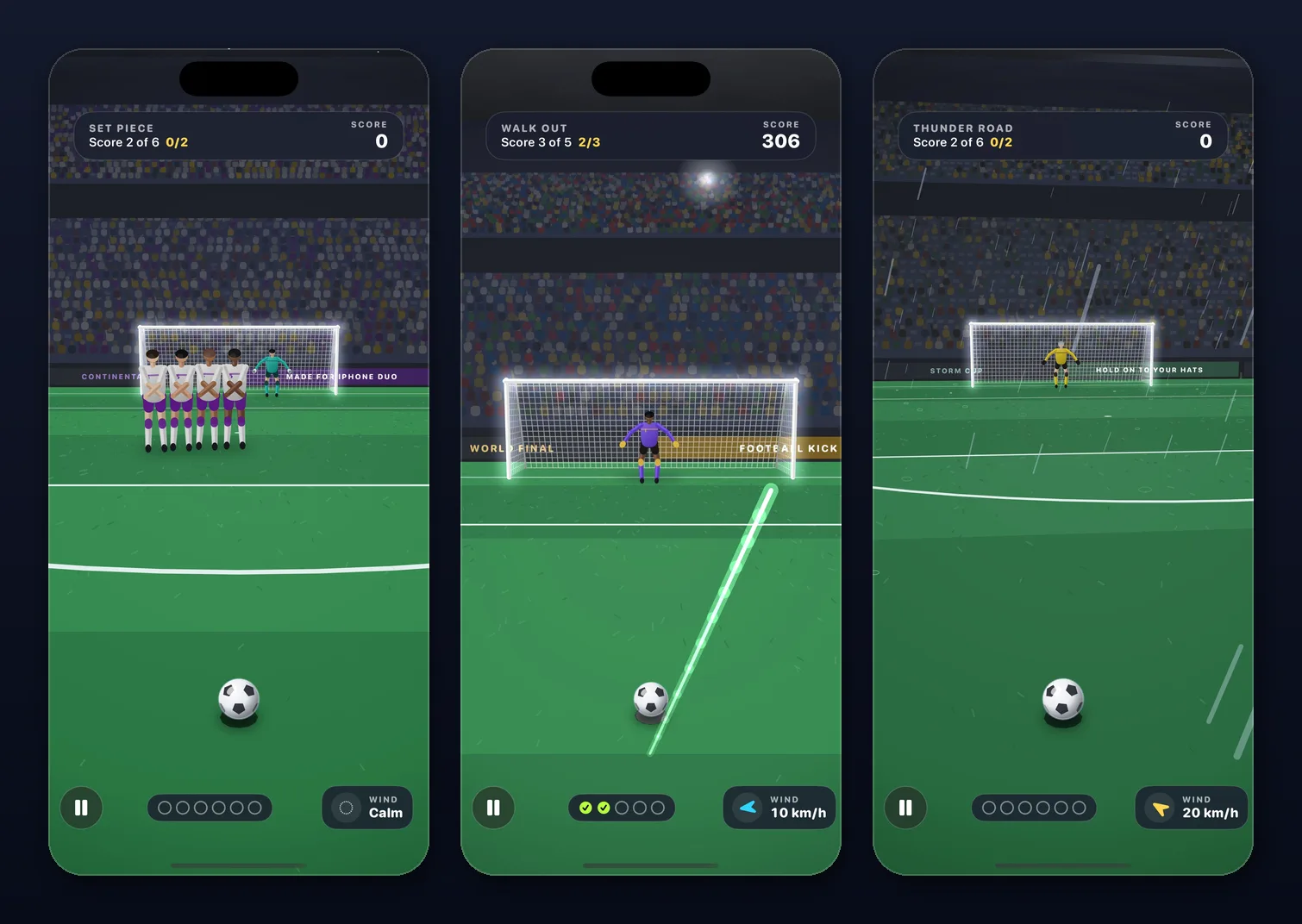
The Magnus effect in football: why a spinning ball curves
A spinning ball drags a thin layer of air round with it. Where the ball’s surface moves the same way as the air flowing past, the air travels faster and its pressure drops. On the opposite side the air is slowed and the pressure rises, so the ball is pushed towards the fast, low-pressure side. That is how Takeshi Asai and Takao Akatsuka of Yamagata University and Steve Haake of Sheffield Hallam University explained it in Physics World in 1998, quoting J. J. Thomson’s rule from 1910 that “the ball follows its nose”.1 It swerves the way its front is turning.
The axis of the spin sets the direction of the push. Spin about an upright axis bends the ball left or right. Topspin, with the top of the ball rolling forward, pushes it down, so it dips. Backspin pushes it up, which is how a goal kick struck with backspin carries further.2 A tilted axis gives some of each.
In the Physics World example, a ball travelling at 25 to 30 m/s and spinning 8 to 10 times a second feels a sideways force of about 3.5 N. On a ball of 410 to 450 g that’s an acceleration of about 8 m/s². Over a 30 m kick lasting about a second, it can move the ball up to 4 m off a straight line.1 Real kicks are in that range. When Asai’s group measured players’ curve kicks in 2004, the ball left the foot at 27.1 m/s on average, spinning 7.8 times a second.3
Why the bend comes late
The free kick that physicists keep coming back to is Roberto Carlos’s for Brazil against France in 1997. The ball was 30 to 35 m out, depending on whose estimate you take. Carlos struck it with the outside of the left foot, so far to the right that it flew at least a metre wide of the wall, spinning anticlockwise as seen from above. Then it swung left and went in.14 J. W. M. Bush, a mathematician at MIT, reckons that had it flown straight it would have crossed the goal line near the edge of the penalty area.2
There are two published explanations for the late swerve. Asai, Akatsuka and Haake suggested that Carlos struck the ball fast enough for the air at its surface to be turbulent, which keeps drag low. Around the wall it slowed into smooth, laminar flow. The drag rose, the ball slowed faster, and the same spin bent it harder. Experiments on golf balls also found the lift coefficient for a given spin rising as the ball slows.1
In 2010 Guillaume Dupeux, Anne Le Goff, David Quéré and Christophe Clanet, French physicists, showed that a spinning ball curls more as it slows even without that change in the flow. Drag grows with the square of a ball’s speed, while the sideways force from steady spin grows only in proportion to it. In their model the curvature of the path goes as spin divided by speed, so a ball that keeps its spin while it slows bends more and more tightly, into a spiral. For a football they put the distance over which drag noticeably slows the ball at about 54 m. They read Carlos’s kick, from about 35 m, as long enough for the bend to tighten sharply near the goal.4
Physics World’s advice follows from either explanation. Hit the ball hard enough that it is still fast at the wall, and practise until the swerve starts just after the ball has passed it.1
The knuckleball free kick: why a ball with no spin wobbles
A knuckleball free kick is struck hard through the middle of the ball, with almost no spin. To see why it wobbles, start with drag. At low speed the thin layer of air on a ball’s surface is smooth, or laminar, and it breaks away early, leaving a wide wake and high drag. At higher speed the layer turns turbulent, clings to the ball for longer and leaves a narrower wake, so drag falls sharply. That fall is the drag crisis.1 In wind-tunnel tests by Takeshi Asai and Kazuya Seo, the drag coefficient of a 32-panel match ball dropped from about 0.47 below the crisis to about 0.18 above it. For that ball the crisis came at roughly 11 to 19 m/s.5
With no spin there’s no steady Magnus force to set the direction, and nothing holds the wake in place. Taketo Mizota and colleagues in Fukuoka watched the air behind a still ball in a wind tunnel. A pair of trailing vortices wandered around its back, and the force on the ball pointed away from wherever they sat. Balls fired from a machine at 22.8 and 29.2 m/s, turning about once a second, flew erratically in more than 80% of flights and drifted up to about 0.9 m. Experiments they cite put the change from random to nearly steady flight at two to three revolutions a second.6
Kicking robots show the same scatter. At the University of Tsukuba, Sungchan Hong and Takeshi Asai had a robot kick balls at a goal 25 m away, at 30 m/s and with less than one rotation. It kicked each ball 20 times in each of two panel orientations. The sideways spread of the impact points, as a standard deviation, ran from about 0.2 m for the steadiest ball to 0.68 m for the least steady.7 Reports gathered by Baptiste Darbois Texier and colleagues put football knuckleballs at about 20 to 25 m/s, inside the 15 to 25 m/s range where a football goes through the drag crisis. In their simulations each zigzag takes about 0.7 s, less than the second they allow for a player to react.8
The strike looks different too. Hong and colleagues measured the angle between the face of the foot and the direction of the swing at impact. It was about 4° for a knuckling shot, against 20° for a straight shot and 33° for a curler. For a knuckleball the foot moves mostly straight through the ball.9 Bush notes that many free-kick specialists aim for the valve, where the ball is stiffest, to keep the contact short.2
Five kinds of free kick, compared
Brazilian players have names for four styles of free kick, and in Bush’s account of free kick physics two effects explain all of them, the Magnus force and the knuckle.2 The table adds the driven shot, with the spin and wobble figures from the studies above.3610
| Free kick | How it’s struck | Spin | What the ball does | Why |
|---|---|---|---|---|
| Curler (chute de curva) | Inside of the foot, off-centre, sweeping across the ball | Side spin, 7.8 revolutions a second on average in players’ curve kicks | Bends by several metres, most of it late | Magnus force, which gains on drag as the ball slows |
| Outside-of-the-foot curler (trivela) | Outside of the foot, with the outer toes | Side spin the other way | Bends the opposite way to an inside-foot curler from the same foot | Magnus force; the small contact area makes it harder to control |
| Dipping top-spin (folha seca, “dry leaf”) | Brushing over the ball | Nearly pure topspin | Dips sharply, like a falling leaf | Magnus force pointing down |
| Knuckleball (pombo sem asa) | Hard and clean through the middle, foot square to the swing | Almost none, about one revolution a second or less | Wobbles sideways and up and down, by up to about 0.9 m | Vortices moving in the wake, strongest around the drag crisis |
| Driven | Laces through the middle of the ball | Little side spin | Flies fast and close to straight | Above the drag crisis, drag stays low |
Bush calls pure topspin from a dead ball extremely difficult, mastered by only a few players.2 The driven shot and the knuckleball differ mainly in spin. A driven shot that leaves the foot with almost none, at 20 to 30 m/s, is in the range where the studies above saw balls knuckle.
How to bend a free kick with your foot
England Football Learning, the FA’s coaching site, explains how to curve a football for a curled pass in three steps, and a curled free kick uses the same strike.10
- Approach the ball at an acute angle.
- Plant your standing foot beside the ball, angled towards its front.
- Wrap your kicking foot round the opposite side of the ball, using your instep.
Research on the strike shows where the spin comes from. In simulations of the foot meeting the ball, Asai and colleagues found that spin rose mainly with how far off-centre the foot struck, peaking at an offset of about 100 mm. Grip mattered less. Going from a frictionless foot to a very grippy one added at most 13 rad/s. Offsets that gave more spin also gave less ball speed.11 Physics World’s short version is to strike slightly off-centre with the front of the foot, with the ankle bent into an L.1
Aim outside the target. Because most of the bend comes late, a curler has to start wide of where it will finish, the way Carlos’s ball started a metre wide of the wall. Wet weather costs spin. A ball still picks up some spin from a frictionless strike, because it deforms round the foot, but much less than in the dry. Physics World’s advice is to dry the ball and your boots.1 Bush adds that a waterlogged ball is heavier and more slippery, so it takes less spin and bends less for the spin it has.2
The wall, the keeper and the 9.15 metres
Law 13 of the Laws of the Game sets the distance. As of 30 October 2026, defenders must stay at least 9.15 m (10 yards) from the ball until it is kicked and clearly moves, unless they’re on their own goal line between the posts. When three or more of them form a wall, attackers must stay at least 1 m from it. The ball has to be stationary. A direct free kick can be scored straight from the kick, and an indirect one that goes straight in gives a goal kick.12
The distance shapes the kick. A ball that goes round the wall has to pass outside its end and then bend back inside the post. One that goes over has to clear the defenders’ heads 9.15 m away and still come down under a crossbar 2.44 m high.13 A late bend suits the first. Topspin suits the second, because it pulls the ball down faster than gravity alone would.
Curl also fools the eye. Cathy Craig and colleagues showed professional players free kicks in virtual reality, with and without 600 rpm of side spin. From a viewpoint in the middle of the goal, the players judged whether each kick would go in. Side spin shifted their answers, because they didn’t allow for the ball’s continuing change of direction. The authors concluded that the visual system isn’t suited to judging that kind of accelerating motion, which may be why keepers misjudge curled free kicks.14
How Football Kick models a free kick
Football Kick’s engine, KickKit, is plain Swift, and the browser game runs a JavaScript port of it. It flies the ball with gravity and three more effects. Drag acts against the ball’s motion through the air, so the wind counts. The Magnus term is the spin crossed with the ball’s velocity through the air, times a constant. Spin decays in flight, losing about 16% each second. KickKit adds these up in fixed steps of 1/600 of a second and carries any leftover time into the next frame, so a shot plays out the same whatever the frame rate. The same swipe always gives the same kick, which is why the instant replay can run the exact kick again.
The table sets the engine’s numbers beside the research. The engine’s column comes from KickKit’s source code, and the arithmetic in it is ours. We haven’t timed or filmed any kicks for this post.
| Football Kick’s engine | Measured or estimated for real kicks | |
|---|---|---|
| Ball speed | 12.5 to 24 m/s for the softest strike, depending on distance; 33.5 m/s for the hardest | 27.1 m/s on average in players’ curve kicks |
| Side spin | Up to 63.75 rad/s, about 10 revolutions a second | 7.8 revolutions a second measured; 8 to 10 in Physics World’s example; 600 rpm (10 a second) in Craig’s study |
| Sideways push from spin | About 7.9 m/s² at full spin and 27 m/s (0.0046 × 63.75 × 27) | About 8 m/s² in Physics World’s example |
| Drag coefficient | About 0.25 at every speed | About 0.47 below the drag crisis and 0.18 above it, for one 32-panel ball |
| Knuckleball | Not modelled | Erratic flight at 22.8 to 29.2 m/s, turning about once a second |
The research column comes from the studies above.311456 KickKit’s drag constant, 0.0133 per metre, folds the air density, drag coefficient, cross-section and mass of the ball into one number. With the engine’s ball, 0.11 m in radius and 0.43 kg, and air at 1.2 kg/m³, it works out to a drag coefficient of about 0.25. The game keeps it constant, so there is no drag crisis, and a ball struck without spin flies true unless the wind moves it. Football Kick has no knuckleball.
One setting departs from physics on purpose. The wind counts 1.8 times as much as it would on a real ball, which the code’s comment says is so that it matters on short kicks too. Each shot’s wind is drawn from a range, up to 38 km/h on Practice’s storm setting, and it gusts and can swing round during the shot. The flags and the wind badge show what it’s doing.
The engine does reproduce the late curl that Dupeux’s team describes. Its Magnus term grows with the ball’s speed and its drag with the square of that speed, so a ball that slows faster than it loses spin curls harder towards the end of its flight.
How to curve the ball in Football Kick
Swipe speed is power. The game measures your finger’s speed mostly over the last 60 milliseconds before you let go, and 2,900 screen points a second is full power. On a phone, and in the browser game, the ball is aimed at the spot under your finger when you lift it, measured on the plane of the goal.
On iPhone Duo’s flat half the swipe works differently. Its direction across the grass aims left or right, and its length sets the height. A swipe as long as the gap from the ball to the fold aims 3.05 m up, above the 2.44 m crossbar, so stop short of the fold.
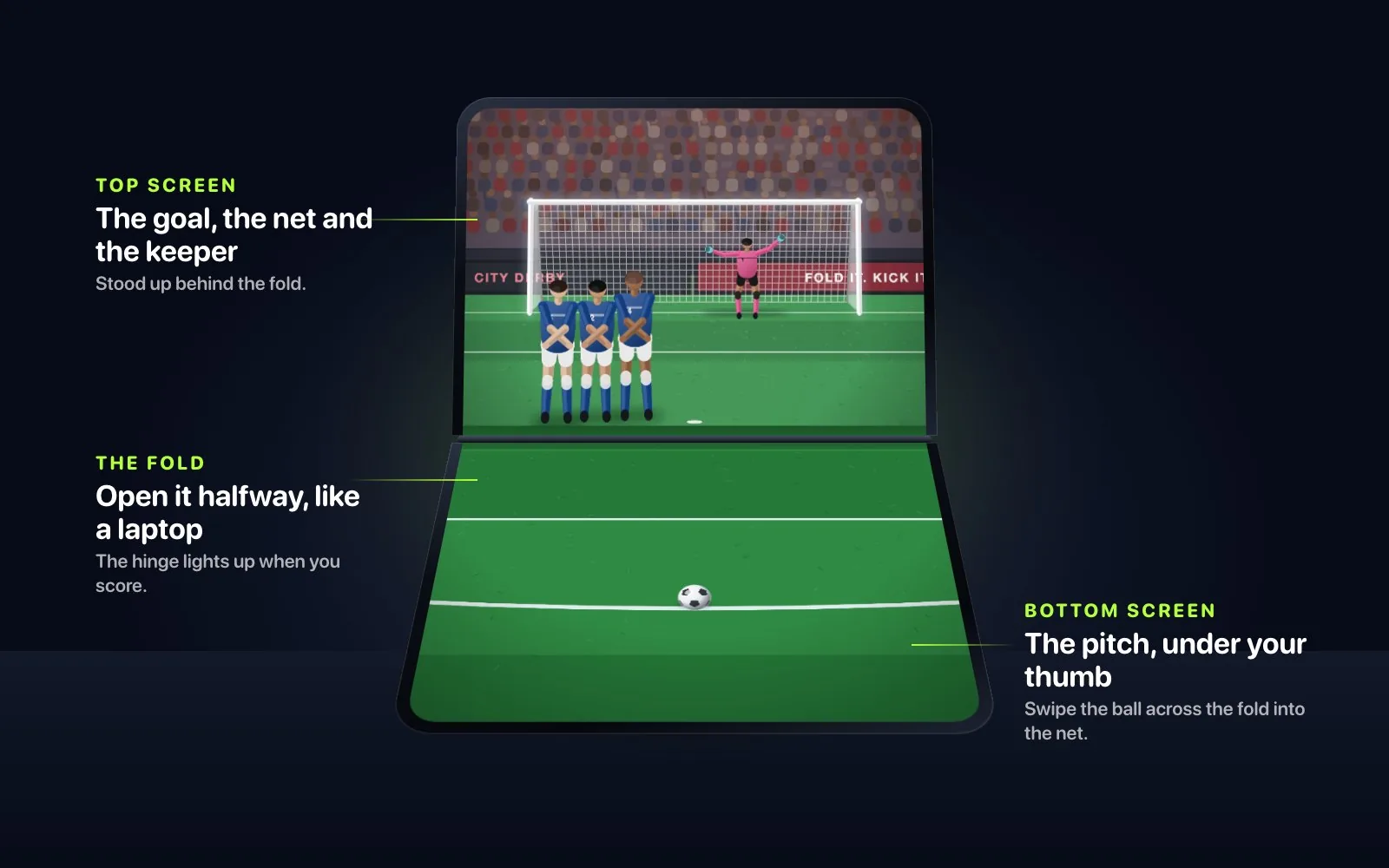
Bend comes from the shape of the swipe. The game measures how far the path bows away from the straight line between its ends. A bow under 3.5% of the swipe’s length counts as straight, and 20% gives full bend, which is about 10 revolutions a second of side spin. The ball follows the shape of the swipe, so if you bow it out to the right, the ball sets off to the right and curls back to the left. In still air the bend doesn’t move the target, because the game solves for a launch that still arrives where you aimed. It changes the route instead, and a curved route is what gets the ball round a wall. A goal earns the curler bonus when the swipe has at least 45% of full bend and the ball crosses the line at least 0.55 m from where its launch line would have taken it.
Pace changes the spin as well. Above 62% power the game adds topspin, up to 22 rad/s at full power, so hard shots dip. A soft shot, under 40% power and aimed more than 1.1 m up, gets 9 rad/s of backspin and floats.
Version 1.0, which we’re finishing now, has free kicks from 18.5 to 24 m out in its World Tour, against walls of three or four, and in Quick Play and Practice. These rules in the engine matter most round a wall:
- Aim at the target and bow the swipe out past the end of the wall. The ball starts on the side you bowed towards and comes back to where you aimed.
- Curl it round the outside end of the wall. The wall lines up 9.15 m from the ball across the near post. The keeper moves towards the other post, by 0.3 m for each player in the wall, up to 1.25 m. The wall also screens the keeper, who reacts 0.18 s later and can’t guess at the strike.
- Use curl against keepers who don’t read spin. Theo Lund, Gus Pemberton, Rafa Ortega and Viktor Hale predict the ball’s path as if it had no spin, much like the players in Craig’s study. Kenji Arata and Idris Okafor read curve, so beat them with pace and the corners.
- Hit it hard to go over. Swipe long on iPhone Duo, or end the swipe high on a phone, and above 62% power the topspin brings the ball down. The tip on the level called The Wall is to swipe long and dip it.
- Read the wind. It moves soft shots most, so in a crosswind hit harder and aim into it.
The free browser game at footballkicks.9io.ai runs the same engine in Just Kick, Penalties and Streak, for five minutes of play a day, as of 30 October 2026. It has no walls, but the swipe reading is the same, so you can practise power, aim and curl there, and a bent goal still scores as a curler. Free kicks, walls, the World Tour and the iPhone Duo views are app-only. If you practise on penalties there, our post on where to aim a penalty kick covers where to put them, and the launch post covers how the game uses iPhone Duo’s fold.
A free kick checklist, on the pitch and in the game
On the pitch
- Decide before your run-up whether the ball goes round the wall, over it or at goal with no spin.
- For a curler, approach at an angle, plant your standing foot beside the ball and wrap your instep round the far side.
- Strike off-centre for spin, and expect to give up some pace for it.
- Start the ball outside the target, because the bend comes late.
- For a knuckleball, strike hard through the middle with the foot square to the swing.
- In the wet, dry the ball and your boots.
- Expect the wall 9.15 m away, and keep your teammates at least 1 m from it.
In Football Kick
- Aim at the target (on a phone, finish the swipe on it), and bow the swipe the way you want the ball to travel.
- Swipe hard to dip the ball over the wall.
- Curl round the outside end of the wall while the keeper covers the far side.
- Use curl against Theo, Gus, Rafa and Viktor, and pace and the corners against Kenji and Idris.
- In a crosswind, hit harder and aim into it.
-
Physics World, “The physics of football” (Takeshi Asai, Takao Akatsuka and Steve Haake, 1 June 1998), https://physicsworld.com/a/the-physics-of-football/ ↩↩↩↩↩↩↩↩↩
-
MIT Department of Mathematics, “The aerodynamics of the beautiful game” (J. W. M. Bush), https://thales.mit.edu/bush/wp-content/uploads/2013/11/Beautiful-Game-2013.pdf ↩↩↩↩↩↩
-
The Engineering of Sport 5, “A fundamental study of an infront curve kick in football” (Asai, Takano, Carré and Haake, 2004), https://shura.shu.ac.uk/2206/ ↩↩↩
-
New Journal of Physics, “The spinning ball spiral” (Dupeux, Le Goff, Quéré and Clanet, 2 September 2010), https://iopscience.iop.org/article/10.1088/1367-2630/12/9/093004 ↩↩
-
SpringerPlus, “Aerodynamic drag of modern soccer balls” (Asai and Seo, 19 April 2013), https://link.springer.com/article/10.1186/2193-1801-2-171 ↩↩
-
Scientific Reports, “The strange flight behaviour of slowly spinning soccer balls” (Mizota and others, 22 May 2013), https://www.nature.com/articles/srep01871 ↩↩↩
-
Scientific Reports, “Effect of panel shape of soccer ball on its flight characteristics” (Hong and Asai, 29 May 2014), https://www.nature.com/articles/srep05068 ↩
-
New Journal of Physics, “Physics of knuckleballs” (Darbois Texier, Cohen, Quéré and Clanet, 13 July 2016), https://iopscience.iop.org/article/10.1088/1367-2630/18/7/073027 ↩
-
Japan Society of Mechanical Engineers, “A fundamental study on knuckling shot in soccer” (Hong and others, 2011), https://www.jstage.jst.go.jp/article/jsmeshd/2011/0/2011_17/_article/-char/en ↩
-
England Football Learning, “Different passing techniques in football” (18 April 2023), https://learn.englandfootball.com/articles-and-resources/coaching/resources/2023/Different-passing-techniques-in-football ↩↩
-
Sports Engineering, “The curve kick of a football I: impact with the foot” (Asai, Carré, Akatsuka and Haake, 2002), https://shura.shu.ac.uk/2127/ ↩
-
The IFAB, “Law 13: Free Kicks”, https://www.theifab.com/laws/latest/free-kicks/ ↩
-
The IFAB, “Law 1: The Field of Play”, https://www.theifab.com/laws/latest/the-field-of-play/ ↩
-
Naturwissenschaften, “Judging where a ball will go: the case of curved free kicks in football” (Craig and others, February 2006), https://pure.qub.ac.uk/en/publications/judging-where-a-ball-will-go-the-case-of-curved-free-kicks-in-foo/ ↩↩
Frequently asked questions
How do you bend a free kick?
Strike the ball off-centre so it spins. A right-footer strikes it right of centre with the inside of the foot, which spins it anticlockwise as seen from above and curls it to the left. Start it outside your target, because most of the bend comes late, after the ball has passed the wall.
What is the Magnus effect in football?
It’s the sideways force on a spinning ball. The spin speeds up the air on one side of the ball and slows it on the other, and the pressure difference pushes the ball towards the faster side. Physics World’s worked example puts it at about 3.5 N for a free kick at 25 to 30 m/s spinning 8 to 10 times a second, enough to move the ball up to 4 m over 30 m.
What is a knuckleball free kick?
A free kick struck hard through the middle of the ball with almost no spin. With no steady Magnus force, the shifting vortices behind the ball push it about, so it wobbles sideways and up and down. In one study, balls fired at 22.8 and 29.2 m/s, turning about once a second, flew erratically in more than 80% of flights.
How far away is the wall at a free kick?
At least 9.15 metres (10 yards) from the ball until it is kicked and clearly moves, under Law 13 of the IFAB’s Laws of the Game as of 30 October 2026. When three or more defenders form a wall, attacking players must stay at least 1 metre from it.
How do you curve the ball in Football Kick?
Bow your swipe. The ball follows the shape of the swipe, so a swipe that bows out to the right sends the ball out to the right and curls it back to the left. On a phone, end the swipe on your target: in still air the ball arrives where your finger lifts.
Can you take free kicks in Football Kick’s browser game?
No. As of 30 October 2026, footballkicks.9io.ai plays Just Kick, Penalties and Streak for five minutes a day, which is enough to practise power, aim and curl. Free kicks, walls and the World Tour are in the app, which is on its way to the App Store.
Building something like this?
9io is a small team of senior engineers with a fractional CTO. We work by the hour, and plans start at $5,000. Send us a note about your product. The reply comes from the person who'd do the work.